Friday, 28 February 2014

A WOLF'S ROLE IN THE ECOSYSTEM: Trophic Cascades

A young forest service employee named Aldo Leopold, charged with killing wolves in New Mexico in the early 1900's started to notice that as the wolves died off, the deer population boomed and ate all the plants to nothing. In his groundbreaking work, "Thinking Like a Mountain", Leopold put forth an idea 50 years ahead of his time: predators control ecosystems.

Since the reintroduction of wolves to Yellowstone National Park in 1995, we have learned much about the effect large carnivores have on an ecosystem. In the past it was thought that an ecosystem was built from the bottom up... with plant life as the basis from which everything grew. Once healthy plants were established, insects, small rodents, birds, larger herbivores and finally the top predators fell into a balance with each other. Almost all conservation and reintroduction efforts were based on this idea. In a damaged area, biologists would first try to rebuild the plant life before doing anything else. However, some ecosystems could not be fixed before reintroducing an endangered top-level animal. In Yellowstone National Park, the US Fish and Wildlife Service was required by the Endangered Species Act to reintroduce wolves before balancing the plant base and herbivore populations.

In the years since the wolf reintroduction, Yellowstone has become a premiere scientific laboratory for wilderness observation and ecosystem recovery. Scientists have come from around the world to watch the effect wild wolves have on the park. They have discovered that an ecological effect called the “trophic cascade” has taken over Yellowstone, with the wolves initiating a more natural ecosystem balance than has been seen in over 65 years:

Tuesday, 4 February 2014

LIAN PIN KOH: A drone's-eye view of conservation

Ecologist Lian Pin Koh makes a persuasive case for using drones to protect the world's forests and wildlife. These lightweight autonomous flying vehicles can track animals in their natural habitat, monitor the health of rainforests, even combat crime by detecting poachers via thermal imaging. Added bonus? They're also entirely affordable!


Friday, 17 January 2014

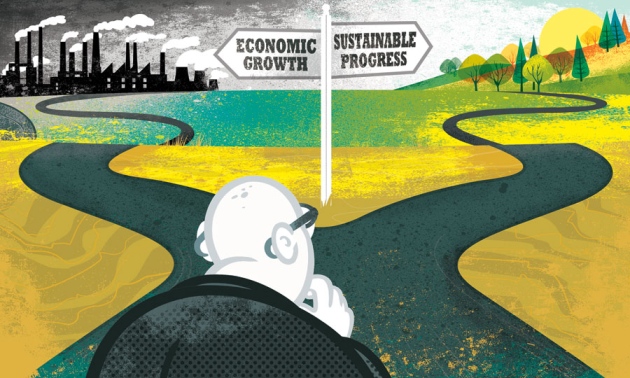
DEVELOPMENT: Time to leave GDP behind

 
ILLUSTRATION BY PETE ELLIS/DRAWGOOD.COM
 
Robert F. Kennedy once said that a country's gross domestic product (GDP) measures “everything except that which makes life worthwhile”. The metric was developed in the 1930s and 1940s amid the upheaval of the Great Depression and global war. Even before the United Nations began requiring countries to collect data to report national GDP, Simon Kuznets, the metric's chief architect, had warned against equating its growth with well-being.
 
GDP measures mainly market transactions. It ignores social costs, environmental impacts and income inequality. If a business used GDP-style accounting, it would aim to maximize gross revenue — even at the expense of profitability, efficiency, sustainability or flexibility. That is hardly smart or sustainable (think Enron). Yet since the end of the Second World War, promoting GDP growth has remained the primary national policy goal in almost every country1.
 
Meanwhile, researchers have become much better at measuring what actually does make life worthwhile. The environmental and social effects of GDP growth can be estimated, as can the effects of income inequality2. The psychology of human well-being can now be surveyed comprehensively and quantitatively3, 4. A plethora of experiments has produced alternative measures of progress (see Supplementary Information).
 
The chance to dethrone GDP is now in sight. By 2015, the UN is scheduled to announce the Sustainable Development Goals, a set of international objectives to improve global well-being. Developing integrated measures of progress attached to these goals offers the global community the opportunity to define what sustainable well-being means, how to measure it and how to achieve it. Missing this opportunity would condone growing inequality and the continued destruction of the natural capital on which all life on the planet depends.

Dethroning GDP

When GDP was instituted seven decades ago, it was a relevant signpost of progress: increased economic activity was credited with providing employment, income and amenities to reduce social conflict and prevent another world war.
 
But the world today is very different from the one faced by the global leaders who met to plan the post-war economy in 1944 in Bretton Woods, New Hampshire. The emphasis on GDP in developed countries now fuels social and environmental instability. It also blinds developing countries to possibilities for more-sustainable models of development.
ABE FOX/AP
GDP has been in use since the 1944 Bretton Woods meeting.
 
Soaring economic activity has depleted natural resources. Much of the generated wealth has been unequally distributed, leading to a host of social problems5. The philosopher John Stuart Mill noted more than 200 years ago that, once decent living standards were assured, human efforts should be directed to the pursuit of social and moral progress and the increase of leisure, not the competitive struggle for material wealth. Or as the economist John Kenneth Galbraith once observed: “To furnish a barren room is one thing. To continue to crowd in furniture until the foundation buckles is quite another.”

The limits of GDP are now clear. Increased crime rates do not raise living standards, but they can lift GDP by raising expenditures on security systems. Despite the destruction wrought by the Deepwater Horizon oil spill in 2010 and Hurricane Sandy in 2012, both events boosted US GDP because they stimulated rebuilding.

Alternative measures of progress can be divided into three broad groups (see Supplementary Information). Those in the first group adjust economic measures to reflect social and environmental factors. The second group consists of subjective measures of well-being drawn from surveys. The third group relies on weighted composite indicators of well-being including housing, life expectancy, leisure time and democratic engagement.

Adjusted economic measures

These are expressed in monetary units, making them more readily comparable to GDP. Such indices consider annual income, net savings and wealth. Environmental costs and benefits (such as destroying wetlands or replenishing water resources) can also be factored in. One example is the genuine progress indicator (GPI). This metric is calculated by starting with personal consumption expenditures, a measure of all spending by individuals and a major component of GDP, and making more than 20 additions and subtractions to account for factors such as the value of volunteer work and the costs of divorce, crime and pollution6.

Crucially, unlike other measures in the first group, GPI considers income distribution. A dollar's worth of increased income to a poor person boosts welfare more than a dollar's worth of increased income does for a rich person. And a big gap between the richest and the poorest in a country — as in the United States and, increasingly, in China and India — correlates with social problems, including higher rates of drug abuse, incarceration and mistrust, and poorer physical and mental health5.

These adjustments matter. A 2013 study2 comparing the GDP per capita and the GPI per capita of 17 countries comprising just over half the global population found startling divergences between the two metrics. The measures were highly correlated from 1950 until about 1978, when they moved apart as environmental and social costs began to outweigh the benefits of increased GDP (see 'Genuine progress flattens'). Tellingly, life satisfaction is highly correlated with GPI per capita, but not with GDP per capita.

Some governments are taking this seriously. Two US states, Vermont and Maryland, have in the past three years adopted GPI as a measure of progress and have implemented policies specifically aimed at improving it.

Subjective measures of well-being

The most comprehensive of these is the World Values Survey (WVS), which covers about 70 countries and includes questions about how satisfied people are with their lives. Starting in 1981, the WVS is conducted in 'waves', the sixth of which is currently in progress. Another example is the gross national happiness index used in Bhutan. This measure uses elaborate surveys that ask how content people feel in nine domains: psychological well-being, standard of living, governance, health, education, community vitality, cultural diversity, time use and ecological diversity.

Subjective well-being has been highly studied, and has even been recommended as the most appropriate measure of societal progress7. But subjective indicators are tricky to compare across societies and cultures. For example, self-reported health tracks with clinically reported rates of morbidity and mortality within countries but not across them8. And people are not always aware of the things that contribute to their well-being. Few of us give credit to ecosystem services for water supply and storm protection, for example.

Weighted composite measures of several indicators

A comprehensive picture of sustainable societal well-being should integrate subjective and objective indicators9(see Supplementary Information, Figure S1), as these measures begin to do. One example is the Happy Planet Index, introduced by the New Economics Foundation in 2006. This multiplies life satisfaction by life expectancy and divides the product by a measure of ecological impact.

Other indices in the third group combine a range of variables, such as income, housing, jobs, health, civic engagement, safety and life satisfaction. The Better Life Index, developed by the Organisation for Economic Co-operation and Development, maintains a website that allows users to choose how to weight variables, revealing how the emphasis on different variables can influence countries' rankings.

Many other experiments are under way (see www.wikiprogress.org). None of these measures is perfect, but collectively they offer the building blocks for something much better than GDP.
 
Why are we stuck?
 
There is broad agreement that global society should strive for a high quality of life that is equitably shared and sustainable. Several groups and reports have concluded that GDP is dangerously inadequate as a measure of quality of life — including those published by the French government's 2008 Commission on the Measurement of Economic Performance and Social Progress10, the Frederick S. Pardee Center for the Study of the Longer-Range Future11 and the European Commission's ongoing Beyond GDP initiative. That conclusion was also echoed in 'The Future We Want', the declaration of the 2012 Rio+20 UN Conference on Sustainable Development agreed to by all UN member states.

Nonetheless, GDP remains entrenched1. Vested interests are partly responsible. Former US President Bill Clinton's small move towards a 'green GDP', which factored in some of the environmental consequences of growth, was killed by the coal industry. However, much of the problem is that no alternative measure stands out as a clear successor.

Creating that successor will require a sustained, transdisciplinary effort to integrate metrics and build consensus. One potential vehicle for doing this is the setting up of the UN Sustainable Development Goals (SDGs), a process that is now under way to replace the Millennium Development Goals (MDGs). Established in 2000, the MDGs comprise eight basic targets that include eradicating extreme poverty and establishing universal primary education, gender equality and environmental sustainability. Currently both the MDGs and the suggested SDGs are only lists of goals with isolated indicators. But the SDG process can and should be expanded to include comprehensive and integrated measures of sustainable well-being12.

If undertaken with sufficiently broad participation, the hunt for the successor to GDP might be completed by 2015. There are significant barriers to doing this, including bureaucratic inertia and the tendency of governments, academia and other groups to work in isolation. These barriers can be overcome with dedicated leadership. Crucially, people can now communicate across the globe with an ease unthinkable in the days of Bretton Woods.

Any 'top-down' process must be supplemented with a 'bottom-up' engagement of civil society that includes city and regional governments, non-governmental organizations, business and other parties. We recently formed the Alliance for Sustainability and Prosperity (www.asap4all.com) to do just that. This web-based 'network of networks' can communicate research about sustainable quality of life and the elements that contribute to it (see Supplementary Information), and so help to build consensus among the thousands of groups now concerned with these issues.

The successor to GDP should be a new set of metrics that integrates current knowledge of how ecology, economics, psychology and sociology collectively contribute to establishing and measuring sustainable well-being. The new metrics must garner broad support from stakeholders in the coming conclaves.

It is often said that what you measure is what you get. Building the future we desire requires that we measure what we want, remembering that it is better to be approximately right than precisely wrong.

Wednesday, 23 October 2013

SYLVIA EARLE: For the shake of oceans


National Geographic Society Explorer-in-Residence Dr. Sylvia A. Earle, is an oceanographer, explorer, author, and lecturer. She has experience as a field research scientist, government official, and director for corporate and nonprofit organizations. 
Earle is the founder of Deep Ocean Exploration and Research, Inc., founder of Mission Blue and SEAlliance, and chair of the Advisory Councils of the Harte Research Institute and the Ocean in Google Earth.

She has authored more than 190 scientific, technical, and popular publications and lectured in more than 80 countries. Her research concerns marine ecosystems with special reference to exploration, conservation, and the development and use of new technologies for access and effective operations in the deep sea and other remote environments.
Her special focus is on developing a global network of protected areas on the land and in the ocean to safeguard the living systems that provide the underpinnings of global processes, from maintaining biodiversity and yielding basic life support services to providing stability and resiliency in response to accelerating climate change.

Thursday, 3 October 2013

THE STORY OF SOLUTIONS

The Story of Solutions, explores how we can move our economy in a more sustainable and just direction, starting with orienting ourselves toward a new goal.

In the current ‘Game of More’, we’re told to cheer a growing economy – more roads, more malls, more Stuff! – even though our health indicators are worsening, income inequality is growing and polar icecaps are melting.
But what if we changed the point of the game? What if the goal of our economy wasn’t more, but better – better health, better jobs and a better chance to survive on the planet? Shouldn’t that be what winning means?

Sunday, 15 September 2013

EMMANUEL DE MERODE: A Story of Conflict Renewal & Hope

Emmanuel De Merode, Director for Virunga National Park, gives an account of the struggle to save one of the world's great national parks with its population of mountain gorillas. He renders accessible to an audience one of the darkest conflicts in recent history, the bloody civil war in the Democratic Republic of Congo.

It is not just a story of bleak and bloody facts: ultimately it is a story of determination and courage and how a small unit of Congolese park rangers, community workers and local environmental activists brought about a miracle in African wildlife conservation.


Tuesday, 28 May 2013

GEORGE MOUSTAKI: In Memoriam


Je déclare l'état de bonheur permanent
Et le droit de chacun à tous les privilèges.
Je dis que la souffrance est chose sacrilège
Quand il y a pour tous des roses et du pain blanc.
Je conteste la légitimité des guerres,
La justice qui tue et la mort qui punit,
Les consciences qui dorment au fond de leur lit,
La civilisation au bras des mercenaires.


Friday, 24 May 2013

SCARCITY-MIND OR ECO-MIND: Where Do They Lead?

By Frances Moore Lappé The Solutions Journal Volume 4 | Issue 2 | May 2013

 
Julie Falk/Flickr
 
Anthropology, neuroscience, and psychology increasingly recognize that human beings are “soft-wired” for profoundly social behavior, says the author. This puts a better world within reach.
 
Humans see the world through largely unconscious frames that determine what we believe our nature to be and therefore what we believe to be possible. To address our biggest global challenges, we can shed this non-ecological mental map—what the author calls “scarcity-mind”—based in lack and fear. Locked in scarcity-mind, we remain blind to our own power and end up creating together a world that none of us, as individuals, would choose. But humans can actually change how we see, moving from a frame of lack and limits to one of alignment with nature. Based on research in neuroscience, psychology, and anthropology, this article explores a world seen with the emergent “eco-mind” in which possibility is all around us. Thinking like an ecosystem, no one is bereft of power.
 
  • Humans see the world through culturally formed filters that determine what we can and cannot see and what we believe to be possible.
  • Based on core assumptions of separateness, stasis, and scarcity, we see ourselves in perpetual competition with other selfish creatures.
  • These assumptions drive a political and economic system characterized by concentrated power, a lack of transparency, and a culture of blame.
  • Based on assumption of connection, continuous change, and co-creation, we can move away from this toward Living Democracy, which is positively aligned with our nature via the continuous dispersion of power, transparency in human relations, and cultures of mutual accountability.

It’s the GDP-obsessed growth model, many reformers argue, that’s leading us to perdition. They decry the irresponsibility of a relatively few taking more than their share, who are profligate with the earth’s dwindling resources. Certainly this “we’ve hit the limits” framing rings true, for, inarguably, human societies have exceeded the limits of destruction, depletion, and disruption our planet can sustain without massive human and nonhuman loss and suffering.
 
But is there a more effective way of understanding the roots of our predicament?
 
Here’s a possibility.

Click on the link to read the full article: http://thesolutionsjournal.anu.edu.au/node/22191 

Wednesday, 22 May 2013

WATER IN THE ANTHROPOCENE

Water in the Anthropocene is a 3-minute film charting the global impact of humans on the water cycle. Evidence is growing that our global footprint is now so significant we have driven Earth into a new geological epoch — the Anthropocene.

Human activities such as damming and agriculture are changing the global water cycle in significant ways. The data visualisation was commissioned by the Global Water Systems Project for a major international conference (Water in the Anthropocene, Bonn, Germany, 21-24 May, 2013). http://conference2013.gwsp.org 

As datasets build upon one another, the film charts Earth's changing global water cycle, why it is changing, and what this means for the future. The vertical spikes that appear in the film represent the 48,000 large dams that have been built. The film was produced by Globaïa and the International Geosphere-Biosphere Programme. http://globaia.org // http://igbp.net

The film is part of the first website on the concept of humans as a geological force, http://anthropocene.info

Water in the Anthropocene from WelcomeAnthropocene on Vimeo.

Wednesday, 8 May 2013

THE OVERVIEW EFFECT


For more than four decades, astronauts from many cultures and backgrounds have been telling us that, from the perspective of Earth orbit and the Moon, they have gained such a vision.

The overview effect is a cognitive shift in awareness reported by some astronauts and cosmonauts during spaceflight, often while viewing the Earth from orbit or from the lunar surface. It refers to the experience of seeing firsthand the reality of the Earth in space, which is immediately understood to be a tiny, fragile ball of life, hanging in the void.
OVERVIEW from Planetary Collective on Vimeo.

Monday, 25 February 2013

GASLAND

The largest domestic natural gas drilling boom in history has swept across the United States. The Halliburton-developed drilling technology of "fracking" or hydraulic fracturing has unlocked a "Saudia Arabia of natural gas" just beneath us. But is fracking safe? When filmmaker Josh Fox is asked to lease his land for drilling, he embarks on a cross-country odyssey uncovering a trail of secrets, lies and contamination. A recently drilled nearby Pennsylvania town reports that residents are able to light their drinking water on fire. This is just one of the many absurd and astonishing revelations of a new country called GASLAND. Part verite travelogue, part expose, part mystery, part bluegrass banjo meltdown, part showdown.


Friday, 22 June 2012

AGROECOLOGY

Agroecology is a scientific discipline that uses ecological theory to study, design, manage and evaluate agricultural systems that are productive but also resource conserving. Agroecological research considers interactions of all important biophysical, technical and socioeconomic components of farming systems and regards these systems as the fundamental units of study, where mineral cycles, energy transformations, biological processes and socioeconomic relationships are analyzed as a whole in an interdisciplinary fashion.
Agroecology is concerned with the maintenance of a productive agriculture that sustains yields and optimizes the use of local resources while minimizing the negative environmental and socio-economic impacts of modern technologies. In industrial countries, modern agriculture with its yield maximizing high-input technologies generates environmental and health problems that often do not serve the needs of producers and consumers. In developing countries, in addition to promoting environmental degradation, modern agricultural technologies have bypassed the circumstances and socio-economic needs of large numbers of resource-poor farmers.


The contemporary challenges of agriculture have evolved from the merely technical to also include social, cultural, economic and particularly environmental concerns. Agricultural production issues cannot be considered separately from environmental issues. In this light, a new technological and development approach is needed to provide for the agricultural needs of present and future generations without depleting our natural resource base. The agroecological approach does just this because it is more sensitive to the complexities of local agriculture, and has a broad performance criteria which includes properties of ecological sustainability, food security, economic viability, resource conservation and social equity, as well as increased production.
To put agroecological technologies into practice requires technological innovations, agriculture policy changes, socio-economic changes, but mostly a deeper understanding of the complex long-term interactions among resources, people and their environment. To attain this understanding agriculture must be conceived of as an ecological system as well as a human dominated socio-economic system. A new interdisciplinary framework to integrate the biophysical sciences, ecology and other social sciences is indispensable. Agroecology provides a framework by applying ecological theory to the management of agroecosystems according to specific resource and socio-economic realities, and by providing a methodology to make the required interdisciplinary connections.

Monday, 2 April 2012

APOPO: DETECTION RATS TECHNOLOGY!

APOPO is a social enterprise that researches, develops and disseminates detection rats technology for humanitarian purposes. It was initiated in response to the global landmine problem. Landmines pose a structural barrier to any development. Moreover, vulnerable communities remain dependent on imported expertise to address the complex problems of landmine detection and clearance of suspected areas. 

There are currently 66 countries and 7 territories around the world that are affected by landmines and/or explosive remnants of war. Landmines pose a structural barrier to development and economic growth, long after war ends.
Developing communities remain dependent on imported expertise to address the complex problems of landmine detection and clearance of suspected areas.
Detection of landmines is difficult, dangerous, costly and time-consuming. Currently, many developing countries are under pressure to meet their commitments to become landmine free by the Ottawa deadline (different for every country), but many lack the resources to fulfill that commitment.

APOPO has stepped up its war on landmines and aims to spread the use of its unique rat detection and land release methodology through its Mine Action Programs. APOPO continues to develop combined approaches using existing demining technology as well as its innovative Mine Detection Rats (MDRs), leading to greater land release rates. In addition to the current use of these HeroRATs in clearance procedures, the role of rats in technical survey is also being explored, which will have a positive effect on overall efficiency of releasing land.

WHY RATS?
Rats have an exceptional sense of smell, and can be trained to detect explosives. Unlike metal detectors, they can detect both metal and plastic-cased landmines.
Rats provide a low-tech solution to the landmine problem, especially in low-resource environments.
Rats are light-weight (approximately 1.5 kg or less) and they will not set off mines when they stand on them (it typically takes 5 kg to set off a pressure-activated landmine).
Rats are very sociable and easy to train, and they don't mind performing repetitive tasks (in exchange for a sweet reward!)
Rats are small and very cheap to feed, maintain, and transport.
Rats are motivated by food, and are less emotionally tied to their handlers than dogs - it is therefore easier to transfer them between handlers.
Rats require little veterinary care, are resilient to many tropical diseases and are highly adaptable creatures.
African giant pouched rats have a long life span (6-8 years) which means a solid return on the initial training investment.

APOPO currently has Mine Action Programs in Mozambique and Thailand. Since 2006 APOPO has run a fully operational mine clearance program in Mozambique, and in 2008 was tasked as the sole operator for continuing the clearance of Gaza Province. The goal is to clear all known remaining minefields in Gaza Province by 2014, in accordance with Mozambique’s mine-ban treaty extension request deadline.

For more information visit:

Monday, 12 March 2012

SOBRE EL 'LOBBIE' MILITAR

"La conjunción de un establishment militar inmenso y de una gran industria armamentística es nueva en Estados Unidos […] Debemos protegernos contra la adquisición de una influencia injustificada del complejo de la industria militar. La posibilidad desastrosa de una acumulación de poder inapropiado existe y persistirá". Con estas palabras el presidente y general militar estadounidense Dwight D. Eisenhower alertaba en 1961, en su discurso de despedida a la nación, y al mundo, de lo que estaba por venir: la indomable influencia del entramado de la guerra en la política estadounidense.

Desde entonces Washington ha lanzado cuatro guerras. En ellas se ha gastado alrededor de 2 billones de dólares, sin contar los gastos de reconstrucción, el cuidado a los veteranos o los intereses de los préstamos adquiridos: alrededor de 700.000 millones de dólares actuales en Vietnam, 100.000 millones en la Guerra del Golfo, 800.000 millones en Irak y 320.000 millones en Afganistán, según datos del Congreso. Y estas delirantes cantidades de dinero son sólo una parte del presupuesto de Defensa, que ronda el 25% del total anual, casi un billón de dólares en 2011. El equivalente al PIB español.

Con todos esos dólares en juego no es de extrañar que se considere al complejo de la industria militar estadounidense como uno de los lobbies más poderosos del mundo. Su impacto fuera de las fronteras del país norteamericano adquiere la forma de guerras e invasiones, de muerte y destrucción. Dentro, se plasma en el llamado Triángulo de Hierro formado por el Pentágono, los contratistas militares y los cabilderos. Los peces gordos de esta industria son las multinacionales Lockheed Martin, Boeing y General Dynamics. Lockheed Martin es el epítome del poder del lobby de la industria de Defensa. En 2008 se convirtió en la compañía que más cobró por contratos con el Estado en la Historia del país: 36.000 millones de dólares (unos 27.300 millones de euros), según cálculos de
FedSpending.org. La cifra supone un tercio de lo que el país se gastó en educación ese mismo año.

¿Cómo lo hizo? Sólo en las gestiones directas y registradas, Lockheed se gasta cada año unos 15 millones de dólares, según datos públicos recopilados por la organización OpenSecrets. La Lockheed Martin es, por ejemplo, el principal contribuyente de las campañas electorales de Howard McKeon, el jefe del Comité de Servicios Armados de la Cámara de representantes. Otros dos de sus principales contribuyentes son, precisamente, Boeing y General Dynamics. Europa tiene ejércitos poderosos y armamento sofisticado, aunque rara vez los utiliza y eso la hace menos apetitosa que EE UU para las grandes firmas de Defensa.

El dinero gastado en cabildeo en Bruselas por esas empresas es del orden de ocho veces menor de lo que las mismas se gastan en Washington. Pero no es inmune: todas las principales empresas armamentísticas tienen oficina en Bruselas. Las grandes son EADS, Thales (Francia), Finmeccanica (Italia), y BAE Systems (Reino Unido). Combinadas, controlan dos tercios de los alrededor de 90.000 millones de euros del mercado europeo. "El acceso privilegiado de la industria [militar] a la política europea en la ausencia casi total de la sociedad civil representa un serio problema democrático en Europa", según un informe de la organización Corporate Europe.
CINCO DE LOS 'LOBBIES' MÁS PODEROSOS
por Mario Saavedra para
Foreing Policy.
Febrero 2012

Wednesday, 28 December 2011

INSIDE JOB

The first film to expose the shocking truth behind the economic crisis of 2008. The global financial meltdown, at a cost of over $20 trillion, resulted in millions of people losing their homes and jobs. Through extensive research and interviews with major financial insiders, politicians and journalists, INSIDE JOB traces the rise of a rogue industry and unveils the corrosive relationships which have corrupted politics, regulation and academia.